Literature Review
MEDPOR® Biomaterial and Porex Surgical Products
Basic
Science
Martinez, J.M., “Use of Multiple Alloplastic Implants for Cosmetic Enhancement of Structural Maxillofacial Hypoplasia” Aesthetic Surgery Journal, Volume 23, Number 6, pp.433-440 (Nov/Dec 2003)
Background: The anthropometric proportions of the maxillofacial skeleton are the foundation on which facial beauty stands.
Objectives: In this article, a procedure for facial cosmetic enhancement of young patients with varying degrees of structural hypoplasia with the use of multiple facial implants is reported.
Methods: Subjective criteria for beauty, proportion and harmony were used by the author as a basis for modifying the structural architecture of the face. Between 1 (one) and 5 (five) alloplastic facial implants per patient were placed in a single procedure.
Results: Since 1989, a total of 500 implants have been placed in 258 patients, with excellent results and a low incidence of complications.
Conclusions: The use of alloplastic implants enables the surgeon to achieve improvements in facial contour that are safe, stable, long-lasting, and cost-effective.
This abstract is provided for educational purposes only. It
contains information about cleared uses of the product. It may contain other
potential uses not cleared by the Food and Drug Administration and not advocated
by the manufacturer. The uses and opinions expressed within the article are
those of the author derived from his or her personal experience with the product.
For additional information on cleared product specific indications and to request
a copy of the cleared labeling please contact the manufacturer's customer care
department.
Wladis, E.J., Wolansky, L.J., Turbin, R.E., Langer, P.D., “Computed Tomographic
Characteristics of Porous Polyethylene Orbital Implants” Presented at the 2003
ASOPRS Scientific Symposium, Anaheim, California (November 15, 2003)
Porous polyethylene sheet implants are frequently used in the surgical management of
several orbital conditions, including the repair of traumatic orbital fractures and the
enhancement of volume in anophthalmic sockets. However, the computed tomographic (CT)
appearance of these implants has not been described, likely due to their lack of
radiodensity. We studied the CT scan characteristics of implanted orbital porous
polyethylene sheets to determine if the location of these implants can be ascertained
radiologically.
Nine patients who had undergone insertion of porous polyethylene orbital implants
were randomly chosen and had post-operative CT scans obtained and reviewed. Three
patients were chosen with implants placed for fractures of the orbital floor, three
for fractures of the orbital medial wall, two for anophthalmic socket volume augmentation,
and one as a replacement for a resected orbital roof and supraorbital rim. In each case,
the implant was easily visualized on CT scan. Since polyethylene implants are porous,
they appear as a hypodense, linear strip on computed tomography that is easily contrasted
against adjacent soft tissue, bone, or mucosa. The mean density of the implants varied
between –30 and –50 Hounsfield units, midway between the mean densities of water and fat.
Though not as easily visualized as radiodense implants such as titanium, porous
polyethylene implants can nevertheless be appreciated on CT scans using soft tissue
windows. Their radiographic density, which approximates that of fat, creates a linear
silhouette that makes them visible against the surrounding tissue. Clinicians should be
aware that they can accurately determine the anatomic location of these implants
post-operatively by computed tomography.
This abstract is provided for educational purposes only. It
contains information about cleared uses of the product. It may contain other
potential uses not cleared by the Food and Drug Administration and not advocated
by the manufacturer. The uses and opinions expressed within the article are
those of the author derived from his or her personal experience with the product.
For additional information on cleared product specific indications and to request
a copy of the cleared labeling please contact the manufacturer's customer care
department.
Uysal, A., Özbek, S., and Özcan, M., “Comparison of the Biological Activities
of High-Density Porous Polyethylene Implants and Oxidized Regenerated
Cellulose-Wrapped Diced Cartilage Grafts” Plastic and Reconstructive
Surgery, Volume 112, Number 2, (August 2003)
The use of alloplastic materials in plastic surgery has become more extensive
with advancement of autogenous-tissue reconstruction technique for the repair
of defects, tissue augmentation, and the stabilization of bones. An ideal
alloplastic material should be non-allergenic, non-carcinogenic,
sterilizable, and easy to shape, and should not cause rejection.
Alloplastic material used for tissue augmentation should have a low rate
of resorption and distortion. High-density porous polyethylene implants
(MEDPOR®) have been used widely and successfully for tissue augmentation.
The Turkish Delight is a material composed of diced cartilage grafts wrapped
in oxidized regenerated cellulose (Surgicel). Its indications are similar
to those of the MEDPOR Implant, and an additional donor site is usually not
needed. Both materials are used in the same anatomical locations, especially
for augmentation. Therefore, the authors evaluated the long-term stability
of and suitable anatomical sites for these materials. MEDPOR Implants or
Turkish Delights were placed subperiosteally or subfacially in 10 young
rabbits, and resultant changes were evaluated 16 weeks after the operation
by macroscopy and histopathology. Changes in projections were measured
with an ocular micrometer. MEDPOR Implants were neither resorbed nor
distorted when placed subperiosteally or subfacially, and were highly
stabilized by the surrounding tissues. Turkish Delights also enabled tissue
augmentation, but had a significantly higher rate of resorption compared
with the MEDPOR Implant and was loosely bound to the surrounding tissue.
The Turkish Delight was less resorbed and better fixed to adjacent tissue
when placed subperiosteally than when placed subfascially.
This abstract is provided for educational purposes only. It
contains information about cleared uses of the product. It may contain other
potential uses not cleared by the Food and Drug Administration and not advocated
by the manufacturer. The uses and opinions expressed within the article are
those of the author derived from his or her personal experience with the product.
For additional information on cleared product specific indications and to request
a copy of the cleared labeling please contact the manufacturer's customer care
department.
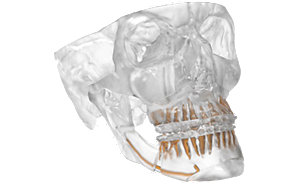
Yaremchuk, M. J., “Facial Skeletal Reconstruction Using Porous Polyethylene
Implants,” Plastic Reconstruction Surgery, 111: 1818, 2003
A retrospective review of clinical outcomes was performed to determine the
clinical utility and morbidity associated with the use of porous polyethylene
facial implants. Three hundred seventy (370) implants were placed in 162
consecutive patients, in 178 operations performed in 11 years. The number
of patients, the number of implants used, and the average follow-up period
were categorized according to the cause of the deformity. The resultant
distribution was as follows: acquired (tumor-related), 17 patients, 39
implants, and 30 months; congenital, eight patients, 31 implants, and
92 months; aesthetic, 39 patients, 97 implants, and 24 months; secondary
post-traumatic, 48 patients, 139 implants, and 37 months; and acute
trauma (internal orbit reconstruction), 50 patients, 64 implants, and
9 months. The distribution of implants according to location was as
follows: frontal, 21; temporal, 30; internal orbit, 145; infraorbital rim,
28; malar, 58; paranasal, 29; nasal 13; mandible, 24; and chin, 22. The
combined average follow-up period per patient was 27 months (range,
immediate postoperative period to11 years). All implants were placed in
the subperiosteal plane, and the majority were fixed with titanium screws.
Antibiotics were administered perioperatively. No implants were extruded
or migrated, formed clinically apparent capsules, or caused symptoms
attributable to bio-incompatibility. The overall re-operation rate was10
percent (n = 16), which included operations to remove implants because of
acute infections (2 percent, n = 3), or a late infection (1 percent, n = 1),
to remove implants causing displeasing contours (2 percent, n = 3), and to
improve contours (6 percent, n = 9). Porous polyethylene implants have
biomaterial properties favorable for facial skeletal augmentation. Screw
application of the implants to the skeleton allows precise predictable
contouring, thus limiting the need for revisional surgical procedures.
This abstract is provided for educational purposes only. It
contains information about cleared uses of the product. It may contain other
potential uses not cleared by the Food and Drug Administration and not advocated
by the manufacturer. The uses and opinions expressed within the article are
those of the author derived from his or her personal experience with the product.
For additional information on cleared product specific indications and to request
a copy of the cleared labeling please contact the manufacturer's customer care
department.
Rubin, P.J., Yaremchuk, M.J. "Morbidity And Facial Implants",
The Art of Alloplastic Facial Contouring, Authors, Terino and Flowers,
Published by Mosby, Chapter 19, pp 273-286 (2000)
The use of implantable biomaterials for bone or soft tissue substitution
has become an integral part of aesthetic and reconstructive surgery
of the face. This review of the scientific literature examines the
risks and complications of these materials. First, we present an
overview of commonly used materials. Second, we address general
considerations of toxicity relevant to all biomaterials. Third,
we present data from a large number of clinical series on the incidence
of complications for individual materials used in specific applications.
This abstract is provided for educational purposes only. It
contains information about cleared uses of the product. It may contain other
potential uses not cleared by the Food and Drug Administration and not advocated
by the manufacturer. The uses and opinions expressed within the article are
those of the author derived from his or her personal experience with the product.
For additional information on cleared product specific indications and to request
a copy of the cleared labeling please contact the manufacturer's customer care
department.
Sclafani, A.P., Romo, T. III "Biology and Chemistry of Facial
Implants", Facial Plastic Surgery, Volume16, Number 1, pp 4-6
(2000)
Facial implants have become increasingly more sophisticated in
the past 10 to 15 years. The concept of "the ideal implant"
has progressed from an inert material that interacts minimally with
the host tissue to one that participates in the normal function
of the tissues. A thorough understanding of their chemical properties
is essential to understand the biologic events that occur around
these materials after implantation. This article outlines the salient
features of common materials encountered in facial implants used
in plastic surgery.
This abstract is provided for educational purposes only. It
contains information about cleared uses of the product. It may contain other
potential uses not cleared by the Food and Drug Administration and not advocated
by the manufacturer. The uses and opinions expressed within the article are
those of the author derived from his or her personal experience with the product.
For additional information on cleared product specific indications and to request
a copy of the cleared labeling please contact the manufacturer's customer care
department.
Wellisz, T., Wallace, R.D. "Porous Polyethylene And Its Biocompatibility",
The Art Of Alloplastic Facial Contouring, Authors, Terino and Flowers
Published by Mosby, Chapter 18, pp 261-272 (2000)
Interest in porous implant materials for use in the facial skeleton
is increasing. Porous polyethylene has become an important facial
reconstructive material that serves both as a bone and cartilage
substitute and as an alternative to silicone. Porous polyethylene
is marketed as MEDPOR® Biomaterial* for use in non-load-bearing
regions of the craniofacial skeleton. The implant is easy to shape,
strong yet somewhat flexible, and highly stable, and most importantly,
it allows ingrowth into its pores. The tissue ingrowth results in
collagen deposition within the pores that forms a highly stable
complex resistant to infection, exposure, and deformation by contractile
forces. 6,28,40 Porous polyethylene is now widely used for mandible
and malar augmentation, nasal surgery, orbital reconstruction, ear
reconstruction, and a variety of craniofacial applications.
This abstract is provided for educational purposes only. It
contains information about cleared uses of the product. It may contain other
potential uses not cleared by the Food and Drug Administration and not advocated
by the manufacturer. The uses and opinions expressed within the article are
those of the author derived from his or her personal experience with the product.
For additional information on cleared product specific indications and to request
a copy of the cleared labeling please contact the manufacturer's customer care
department.
Bigham, W.J., Stanley, P., Cahill, J.M.,
Curran, R.W., Perry A.C. "Fibrovascular Ingrowth In Porous Ocular
Implants: the Effect Of Material Composition, Porosity, Growth Factors,
And Coatings", Ophthalmic Plastic and Reconstructive Surgery, Vol.,
No. 5, pp 317-325 (September 1999)
Purpose: Fibrovascular ingrowth into various porous ocular implants
as a function of implant material composition, porosity, growth
factors, and coatings was investigated in a pilot study in an animal
model.
Methods: Eighty-one New Zealand white rabbits underwent unilateral
enucleation and implantation with ocular implants composed of the
following materials: coralline hydroxyapatite (HA) with 200-mm pores
(HA200) or 500-mm pores (HA500), synthetic HA (synHA), and high-density
porous polyethylene (PP). The HA200, HA500, and PP implants were
implanted untreated or after treatment with recombinant human basic
fibroblast growth factor (Rh-bFGF). Nine HA500 implants were implanted
after coating with calcium sulfate (plaster of Paris) to provide
a smooth outer surface. Implants were harvested at 1-, 2-, 4-, or
8-week intervals and were examined histologically.
Results: A significant difference was found between untreated HA500
and PP, with PP showing better ingrowth. There was no significant
difference between untreated HA and PP, nor between untreated HA500
and synHA. Significant increases in ingrowth were found in HA200
compared with HA500, and in Rh-bFGF-treated implants compared with
untreated controls. The calcium sulfate-coated implants showed less
vascularization compared with the uncoated implants, although the
difference was not significant.
Conclusions: Fibrovascular ingrowth occurred earlier in HA200 implants
than in HA500 implants, and was enhanced when implants were treated
with Rh-bFGF.
This abstract is provided for educational purposes only. It
contains information about cleared uses of the product. It may contain other
potential uses not cleared by the Food and Drug Administration and not advocated
by the manufacturer. The uses and opinions expressed within the article are
those of the author derived from his or her personal experience with the product.
For additional information on cleared product specific indications and to request
a copy of the cleared labeling please contact the manufacturer's customer care
department.
Choi J.C., Iwamoto, M.A., Bstandig, S., Rubin,
P.A.D., Shore, J.W. "MEDPOR® Motility Coupling Post: A Rabbit
Model", Ophthalmic Plastic and Reconstructive Surgery, Vol.
15, No. 3, pp 190-200 (March 1999)
Purpose: To verify if a MEDPOR® porous polyethylene orbital
implant (PPOI, Porex Surgical Inc.), once vascularized, will tolerate
a partially exposed titanium screw on its anterior surface.
Methods: Ten New Zealand white rabbits were enucleated and given
MEDPOR PPOIs. Eight weeks postoperatively, MEDPOR Motility Coupling
Posts (MCP, Porex Surgical Inc.) were placed into the orbital implants.
Clinical tissue tolerance and histologic response to the new device
were noted.
Results: The titanium screws were well tolerated by the animals.
No case of postoperative infection, conjunctival inflammation, conjunctival
erosion, MCP dislocation, or PPOI fragmentation was noted. A fibrous
tissue growth over the titanium head was noted in all screws with
a head height of 2.5 mm. The fibrous tissue overgrowth was not observed
in screws with a head height of 4 mm or more.
Conclusion: During the 6-month observation period, all implanted
MEDPOR MCPs demonstrated favorable tissue tolerance and stable interfaces
between the MCP and the conjunctiva and between the MCP and the
PPOI.
This abstract is provided for educational purposes only. It
contains information about cleared uses of the product. It may contain other
potential uses not cleared by the Food and Drug Administration and not advocated
by the manufacturer. The uses and opinions expressed within the article are
those of the author derived from his or her personal experience with the product.
For additional information on cleared product specific indications and to request
a copy of the cleared labeling please contact the manufacturer's customer care
department.
Cicciarelli, N., Murray, T.G., Croft,
B.H., Voigt, M., Garonzik, S., Hernandez, E. "Magnetically Integrated
Microporous Implant: Evaluation Of Feasibility And Efficacy", Investigative
Ophthalmology and Visual Science, Vol. 40, No. 4 (March 1999)
Purpose: To determine the orbital tolerance of a microporous implant
fitted with an integrated stainless steel post and the enhanced
motility associated with magnetic coupling of the prosthetic.
Methods: Six New Zealand White Rabbits underwent enucleation surgery
under sterile conditions. Each animal was implanted with a 12 mm
microporous polyethylene implant with a 2 x 3 mm stainless steel
post embedded flush within the anterior surface. At one month, the
rabbits were fitted with an external prosthesis containing two 1mm
circular rare earth dental magnets embedded into the porcelain implant
at 0.5 mm off midline (right and left of center at the horizon).
Ophthalmologic and photographic documentation of post enucleation
socket appearance was recorded biweekly. Two animals were euthanized
at each of three time points: 1, 2 and 6 months. The implant and
orbital contents were removed for histopathological examination.
Results: No evidence of toxicity was observed in association with
this integrated ocular implant. There was no evidence of either
conjunctival dehiscence or localized rejection. Clinical grading
of motility documented a significant enhancement in lateral excursion
when compared to nonintegrated controls.
Conclusions: Magnetically integrated microporous implants achieve
excellent enhancement of motility. No evidence of complications
associated with the surgical placement of this prosthetic coupling
implant was found.
CR: None. Support: American Cancer Society, Fight for Sight/Prevent
Blindness America and Knights Templar Eye Foundation.
This abstract is provided for educational purposes only. It
contains information about cleared uses of the product. It may contain other
potential uses not cleared by the Food and Drug Administration and not advocated
by the manufacturer. The uses and opinions expressed within the article are
those of the author derived from his or her personal experience with the product.
For additional information on cleared product specific indications and to request
a copy of the cleared labeling please contact the manufacturer's customer care
department.
Schellini, S.A., Marques, M.E.A., Taga,
E.M., Roca, R., Padovani, C.R. "Comparison Between Synthetic Hydroxyapatite
And Porous Polyethylene In Rabbits Eviscerated Cavities, Investigative
Ophthalmology and Visual Science, Vol. 40, No. 4 (March 1999)
Purpose: To compare the tecidual reaction produced with the spheres
use of synthetic hydroxyapatite and porous polyethylene in eviscerated
cavities of rabbits.
Methods: They were used 56 New Zealand white rabbits underwent
a unilateral evisceration with placement of spheres of synthetic
hydroxyapatite (G1- 28 animals) or porous polyethylene (G2-28 animals).
Four animals of each group were sacrificed in 7 experimental moments:
7, 15, 30, 60, 90, 120 and 180 days after the evisceration. After
the sacrifice, the orbital content was removed and fastened in formol.
Then, the wrapped up sphere was cross-sectional in it largest axis
and prepared for histopatologic exam.
Results: Slack tecidual reaction was observed with both materials,
reaching until the sphere center after 7 to 15 days after the surgery.
The tecidual reaction became denser about 60 to 90 days, period
in that bony metaplasia began in G1. In every observation moment,
G1 had more inflammation than G2. There was a fibrous layer around
the implants that was denser in G1 than in G2 animals. The scleral
cavity area (measured by image analyser) is better maintained in
G2 than in G1 rabbits.
Conclusion: The synthetic hydroxyapatite sphere provoked more inflammation
than the porous polyethylene and it was less efficient in the maintenance
of the cavity volume, what takes us to consider the porous polyethylene
superior to the synthetic hydroxyapatite in the anophthalmiccavity
reconstruction.
This abstract is provided for educational purposes only. It
contains information about cleared uses of the product. It may contain other
potential uses not cleared by the Food and Drug Administration and not advocated
by the manufacturer. The uses and opinions expressed within the article are
those of the author derived from his or her personal experience with the product.
For additional information on cleared product specific indications and to request
a copy of the cleared labeling please contact the manufacturer's customer care
department.
Özgür, F., Aksoy, H.M., Kayikçioglu,
A., Ariyürek, M. "The Effect Of Onlay MEDPOR® Implants
On Mandibular Growth In Young Rabbits: An Experimental Study", Annals
of Plastic Surgery, Vol. 42, No. 2 (February 1999)
MEDPOR® implants were placed on the periosteum of the mandible
in infant rabbits to study their effects on growth. Three months
later radiological and histopathological studies were performed
in situ and after removal of the mandible. The authors demonstrate
that implants did not affect normal development of the mandible;
however, there was a decrease in bone thickness and a mononuclear
cell reaction was caused where the implant came in contact with
the bone.
Among the alloplastic materials, Silicone, Biocoral, Biofax, Proplast,
Teflon, Plasti-pore, Seramic, Polyamide-mesh and hydroxyapatite
have been used both experimentally and clinically. Silicone, methyl
methacrylate, porous hydroxyapatite and porous polyethylene have
been shown to have the necessary biomechanical properties for use
in treatment of complex facial bone defects.
MEDPOR is a white, ultrahigh-density porous polyethylene material.
The biocompatibility of this alloplastic material is well established.
Results: Considerable histological changes are seen on the contact
surface of the bone.
Discussion: During the growth of the animal, MEDPOR caused thinning
of the bony cortex, a periosteal reaction, a mononuclear cell inflammatory
reaction on the surface of the bone and spur formation at the edge
of the implant. Medpor is reported to result in thinning of bone
with low incidence and thickness of the implant does not alter this
effect. There was only one sample that showed thinning of bone histologically.
In conclusion, the adverse effects of MEDPOR implants on the mandibles
were neither shown to retard bone growth nor caused gross asymmetry.
MEDPOR implants have good stability on bone with acceptable adverse
effects.
This abstract is provided for educational purposes only. It
contains information about cleared uses of the product. It may contain other
potential uses not cleared by the Food and Drug Administration and not advocated
by the manufacturer. The uses and opinions expressed within the article are
those of the author derived from his or her personal experience with the product.
For additional information on cleared product specific indications and to request
a copy of the cleared labeling please contact the manufacturer's customer care
department.
Wellisz, T., Lawrence, M., Jazayeri, M., Golshani, S. and Zhou,
Z. "The Deformation Of The Mandible Beneath Alloplastic Implants",
Plastic and Reconstructive Surgery (September 1995)
To determine the effects of three alloplastic implant materials
on bone, silicone, methlymethacrylate and porous polyethylene, 96
implants were placed on the mandibles of 16 rabbits. Both thin (1.5
mm) and thick (6.0 mm) onlays were used to determine the relative
importance of pressure on bone deformation. Fluorescent markers
were administered at different time intervals to evaluate the patterns
of new bone growth. After 12 and 24 weeks, each of the implants
was examined grossly, histologically and under fluorescent microscopy.
The frequency and degree of thinning of the bone were related to
the type of alloplast, as well as to the implant's thickness. Solid
silicone implants were associated with the greatest amount of bone
resorption (p < 0.05). Thicker silicone implants were associated
with a greater degree of thinning (p < 0.05). Bone resorption
beneath the implants was documented by the presence of osteoclasts
actively eroding bone and by changes in the normal patterns of the
fluorescent markers. Both the thin solid methylmethacrylate and
the thin porous polyethylene implants had a low incidence of bone
thinning. Significantly more thinning of the bone was observed with
the thick methylmethacrylate, although this was less than the silicone
groups. The thick porous polyethylene implants did not increase
the incidence of bone thinning.
This abstract is provided for educational purposes only. It
contains information about cleared uses of the product. It may contain other
potential uses not cleared by the Food and Drug Administration and not advocated
by the manufacturer. The uses and opinions expressed within the article are
those of the author derived from his or her personal experience with the product.
For additional information on cleared product specific indications and to request
a copy of the cleared labeling please contact the manufacturer's customer care
department.
Dougherty, W. and Wellisz, T. "The Natural History Of Alloplastic
Implants In Orbital Floor Reconstruction: An Animal Model", The
Journal of Craniofacial Surgery, Vol. 5, No. 1, pp 26-32 (February
1994)
A new animal model was developed in which the condition of an open
fracture in communication with the maxillary sinus was recreated
to evaluate the behavior of alloplastic implants in human orbital
floor reconstruction. Full thickness defects through the maxillary
sinuses (including bone and mucosa) were made in 21 New Zealand
White rabbits. MEDPOR® and silicone implants were placed to
obturate the defects, exposing one surface of the implant to the
open sinus and were examined at 1, 2, 3 and 4 weeks and 2, 4 and
5 weeks after placement. Complete regeneration of sinus wall structures
with closure of the defect occurred more rapidly with the MEDPOR
implant (p < 0.004 at week 4). MEDPOR showed clearing of debris
from within the implant with concomitant vascular soft-tissue ingrowth
at week 1 and bony ingrowth at week 3, resulting in bone and soft-tissue
fixation with overlying mature mucosa. Silicone implants never became
fixated to bone or soft tissue.
This study supports the clinical observation that MEDPOR can be
used successfully in the orbital floor, even when exposed to an
open facial sinus.
This abstract is provided for educational purposes only. It
contains information about cleared uses of the product. It may contain other
potential uses not cleared by the Food and Drug Administration and not advocated
by the manufacturer. The uses and opinions expressed within the article are
those of the author derived from his or her personal experience with the product.
For additional information on cleared product specific indications and to request
a copy of the cleared labeling please contact the manufacturer's customer care
department.
Rubin, P.A.D., Popham, J.K., Bilyk, J.R. and Shore, J.W. "Comparison
Of Fibrovascular Ingrowth Into Hydroxyapatite And Porous Polyethylene
Orbital Implants", Ophthalmic Plastic and Reconstructive Surgery,
Vol. 10, pp 96-103 (1994)
A study using 32 enucleated New Zealand White rabbits was performed
to determine the rate and extent of fibrovascular ingrowth into
14 mm MEDPOR® and hydroxyapatite orbital implants. Wrapped either
in autologous sclera with and without anterior fenestrations or
as unwrapped spheres, the implants were harvested at 6 and 12 weeks.
It was determined that MEDPOR and hydroxyapatite are both capable
of complete vascularization in this animal model.
This abstract is provided for educational purposes only. It
contains information about cleared uses of the product. It may contain other
potential uses not cleared by the Food and Drug Administration and not advocated
by the manufacturer. The uses and opinions expressed within the article are
those of the author derived from his or her personal experience with the product.
For additional information on cleared product specific indications and to request
a copy of the cleared labeling please contact the manufacturer's customer care
department.
Goldberg, R.A., Dresner, S.C., Braslow, R.A. "Animal Model Of
Porous Polyethylene Orbital Implants", Ophthalmic Plastic and
Reconstructive Surgery, Vol. 10, pp 104-109 (1994)
The clinical performance of porous polyethylene implants is evaluated
in 16 enucleated albino New Zealand rabbits implanted with MEDPOR®
and porous coralline hydroxyapatite. In 12 rabbits, MEDPOR implants
were unilaterally inserted and exenterated at 4, 8, 12, 24 and 48
weeks and in four rabbits, hydroxyapatite implants were placed and
exenterated at 6 and 12 weeks. Early postoperative extrusions occurred
in two rabbits with MEDPOR and two rabbits with hydroxyapatite.
There were no extrusions and minimal inflammation occurred in the
remaining 12 implants (inflammation scores with HA reflected a higher
degree of chronic and acute inflammation). MEDPOR was determined
to be well tolerated histologically with only mild chronic inflammation,
thin capsule formation and partial fibrovascular ingrowth. Easily
implanted with minimal "tissue drag" and no brittleness, it is relatively
inexpensive. The authors conclude that porous polyethylene may have
utility as an orbital evisceration and enucleation implant and that
their findings encourage further exploration and refinement of the
material.
This abstract is provided for educational purposes only. It
contains information about cleared uses of the product. It may contain other
potential uses not cleared by the Food and Drug Administration and not advocated
by the manufacturer. The uses and opinions expressed within the article are
those of the author derived from his or her personal experience with the product.
For additional information on cleared product specific indications and to request
a copy of the cleared labeling please contact the manufacturer's customer care
department.
Wellisz, T., Kanel, G. and Anooshian, R.V. "Characteristics Of
The Tissue Response To MEDPOR® Porous Polyethylene Implants
In The Human Facial Skeleton - The Long-Term Effects Of Biomedical
Implants", The Journal of Long Term Implants, Vol. 3, No.
3, pp 223-235 (1993)
The histological findings of MEDPOR® implant specimens taken
from humans are characterized. Thirty-two (32) implants were biopsied
from 24 patients. All specimens, including those biopsied because
of implant exposure, showed soft tissue ingrowth, vascularization
with mature blood vessels and lamellar collagen deposition within
the pores of the implant. Ingrowth was demonstrated in all implants
including those that became exposed, both early and late after implantation.
This abstract is provided for educational purposes only. It
contains information about cleared uses of the product. It may contain other
potential uses not cleared by the Food and Drug Administration and not advocated
by the manufacturer. The uses and opinions expressed within the article are
those of the author derived from his or her personal experience with the product.
For additional information on cleared product specific indications and to request
a copy of the cleared labeling please contact the manufacturer's customer care
department.
Maas, C.S., Merwin, G.E., Wilson, J., Frey, M.D. and Maves, M.D.
"Comparison Of Biomaterials For Facial Bone Augmentation", Archives
of Otolaryngology - Head and Neck Surgery, Vol. 116, pp 551-556
(1990)
A comparision of biomaterials for facial bone augmentation was
performed in various sites in 12 dogs. MEDPOR® implants demonstrated
good stability and tissue ingrowth into its pores. When autogenous
rib grafts were used in areas with overlying tissue mobility such
as the malar region and the chin, resorption of the rib grafts occurred.
Proplast implants were found to be mobile with a reported break-up
and migration of the Proplast implants. Furthermore, distant fragments
of the Proplast implants were found to be surrounded by a large
number of imflammatory cells including phagocytes and multinucleated
giant cells, implying a continued stimulus for an active cellular
response. Bone erosion was noted under two of the Proplast chin
implants.
This abstract is provided for educational purposes only. It
contains information about cleared uses of the product. It may contain other
potential uses not cleared by the Food and Drug Administration and not advocated
by the manufacturer. The uses and opinions expressed within the article are
those of the author derived from his or her personal experience with the product.
For additional information on cleared product specific indications and to request
a copy of the cleared labeling please contact the manufacturer's customer care
department.
Rubin, L.R. "Polyethylene As A Bone And Cartilage Substitute:
A 32-year Retrospective", L. R. Rubin, Editor, Biomaterials In
Plastic Surgery, St. Louis: C. V. Mosby, pp 477-493 (1983)
The author presents a 32-year personal retrospective, describing
his use of low weight polyetheylene granules in facial areas with
different overlaying tissue covers. Surgical techniques are offered,
including steps for preparation and implantation. In chin and malar
implants, holes were made for fibrous tissue ingrowth to affix implants
to underlying bone. He reports an 89.4% success rate (the greatest
area of failure being the nose) with no sarcomas or tumors and minimal
complication. The author concludes that polyethylene, properly embedded
in the orbital floor and malar, mandible and skull regions, could
survive the test of time and be considered a good replacement for
bone or cartilage.
This abstract is provided for educational purposes only. It
contains information about cleared uses of the product. It may contain other
potential uses not cleared by the Food and Drug Administration and not advocated
by the manufacturer. The uses and opinions expressed within the article are
those of the author derived from his or her personal experience with the product.
For additional information on cleared product specific indications and to request
a copy of the cleared labeling please contact the manufacturer's customer care
department.
|